42 Billion Downloads: What the Play Store Numbers Actually Say
Android doesn't win by being fancy. It wins by being everywhere.
In 2025, everywhere kept growing. Consumers spent $49.2 billion on Google Play, 13% more than the year before. Over 100 billion apps went out the door. Behind those numbers sit 1.58 million apps in the catalog and more than a million developers with something published.
Saturating? That isn't the story these numbers tell. Here's what they actually say.
Downloads and money are two different games
The first thing to get straight: downloads and revenue are not the same conversation.
Of those 100 billion-plus downloads in 2025, 36.2 billion were games and 67.7 billion were apps. So non-game apps take the crown on raw installs. But flip to the money side and the picture inverts, games brought in $31 billion of the $49.2 billion total, leaving $19.2 billion for everything else.
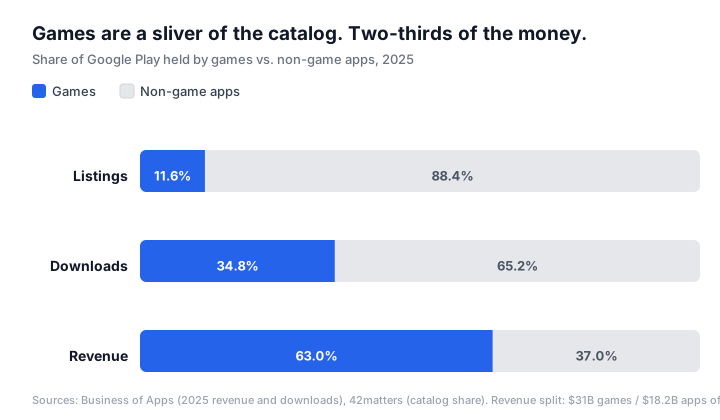
Games are roughly 11.6% of the catalog. They earn two-thirds of the cash.
There's a second trap in the numbers. Something like 97% of Play Store apps are free to download, only about 3% charge upfront. That looks brutal until you remember what it actually means: the install was never the transaction. The relationship is. Monetization on Android happens after the download, through subscriptions, in-app purchases, and ads, which is why revenue can climb 13% in a year when download growth barely moves.
And downloads are slowing. That's not decline, that's a market maturing. Total in-app purchase revenue across both stores grew 10.6% in 2025 while installs grew under 1%. Fewer tire-kickers, more buyers.
The volume machine
Now the games side, where Android's real personality shows.
Google Play delivered 42 billion game downloads in 2025, though that figure is Sensor Tower's count, which runs higher than Business of Apps' 36.2 billion for the same year. Different trackers, different methodology, same direction. Either way: more than four times the App Store's game installs, and about 81% of all game downloads tracked across mobile, PC, and console combined. When someone asks where mobile gaming's audience actually lives, that's the answer.
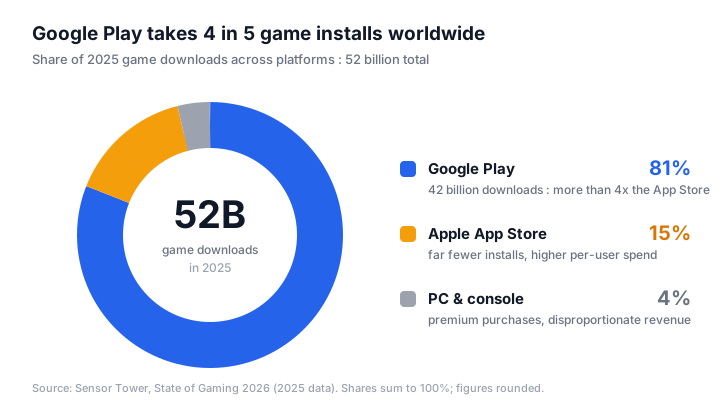
The catalog is expanding fast too. Google Play now carries 150,000+ game titles, up 45.9% year over year, the store is signing up new games faster than ever.
The part that gets written up as bad news: Apple still makes more game money ($52.5 billion versus $30 billion on Google Play). I'd read it differently. Android owns the installs, iOS owns the per-user spend, and those are two genuinely different businesses. One is a reach play at global scale, the other a monetization play in wealthy markets. Neither is failing.
And there's a quiet bright spot in the genre data: strategy was the only genre in 2025 that gained on all three counts at once: revenue, downloads, and time spent. In a year where mobile game downloads dipped 7% industry-wide, one category grew everywhere. That's not a stagnant market.
Where the people are
If you're building Android-first and ignoring emerging markets, you're looking at the wrong map.
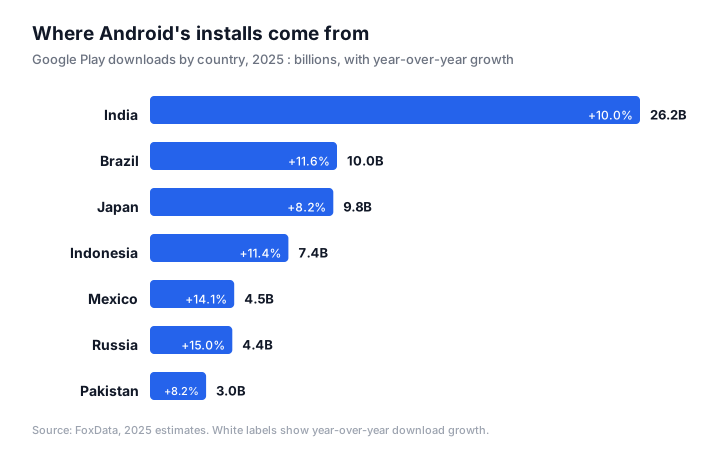
India alone accounted for 26.2 billion Play Store downloads in 2025, nearly three times second-place Brazil. The top five (India, Brazil, Japan, Indonesia, Mexico) pull in tens of billions of installs between them, and the growth is concentrated in exactly the places Android is cheapest and easiest to get.
A few standouts worth watching:
- Brazil, 10 billion downloads, +11.6% YoY, and one of only two top-ten markets where both downloads and monthly active users grew. That dual-positive combination is the real prize; raw installs without engagement are vanity.
- Mexico, +14.1%, one of the fastest-growing large markets.
- Russia, +15%, the fastest grower in the top ten, with positive MAU to match.
There's a structural reason this keeps happening: Android phones cost less, and in price-sensitive markets that's the whole ballgame. Countries like India run on some of the cheapest mobile data on earth. Free-to-download apps built for modest hardware aren't a compromise there, they're the correct product for the audience.
The volume-to-value gap is real, India installs enormously and spends modestly while the US, Japan, and Korea carry the revenue. But engagement growth in Brazil and Indonesia says the funnel is maturing, not stalling. That's the opportunity.
Categories you'd underestimate
Optimism isn't only about scale. It's about where the growth is hiding.
The fastest-growing Play Store categories by downloads over the trailing year aren't the obvious ones:
- Comics, up 84.8%
- Libraries & demo, up 49.9%
- Weather, up 22.5%
- Events, up 21.4%
- Entertainment, up 18.6%
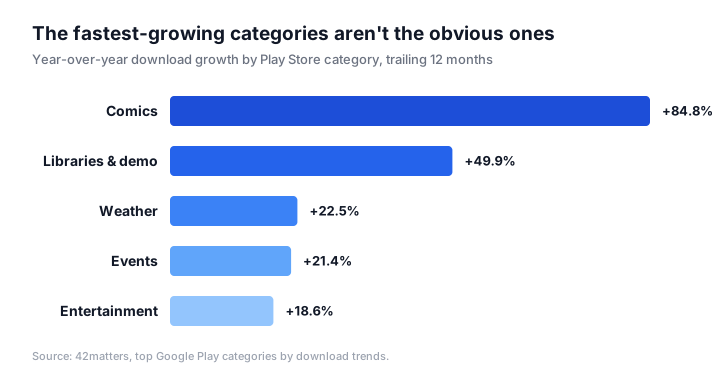
Nobody's keynote is about the weather app category. That's exactly the point. The Play Store isn't a winner-take-all monolith where only the top ten apps matter, niche categories are expanding double digits, and the store is big enough that a focused app in an underserved category can still find real audience.
What to take from this
The numbers above are a snapshot, not a forecast. But a few of them are the kind that don't reverse in a year.
$49.2 billion spent on a store where 97% of apps are free. That only works if the free apps do their job: get installed, get used, and quietly pay later. The money isn't in the download. It's in the second month.
42 billion game installs, and Google Play took 81% of them. If you're building a game and not thinking about Android distribution first, you're optimizing for the smaller half of the market.
India at 26.2 billion downloads with modest spend. Brazil at 10 billion with growing engagement. Those aren't vanity markets anymore. They're the next decade's revenue base, and the developers who learn them now will have a head start when the spend catches up.
And the part that matters most for small studios: 150,000+ games in the catalog, up 45.9% in a year, and strategy was the only genre that grew on revenue, downloads, and time spent together. Crowded, yes. But not locked. A game with a real identity and a store page that's actually optimized still breaks through, and small games that find their audience keep earning long after launch.
Discovery is hard. It always was. But the store is bigger, broader, and more open than it was a year ago, and the developers who treat the boring parts, listing, testing, retention, as the actual work keep finding their audience.
The store isn't getting easier. But it's getting bigger, and bigger stores have more room in them.
---
References
- Business of Apps, Google Play Store Statistics (2026), 2025 revenue ($49.2B), downloads (100B+), catalog size, revenue split, free/paid ratio.
- Sensor Tower, State of Gaming 2026, 52B total game downloads, 42B on Google Play, 81% install share.
- Sensor Tower, State of Mobile 2026, ~150B combined downloads, $167B in-app purchase revenue, +10.6% YoY.
- 42matters, Top Google Play App Categories by Download Trends, category growth (Comics, Libraries, Weather, Events, Entertainment).
- 42matters, via MojoAlerts / Mobile App Statistics, 2.51M apps, 777K+ publishers, 88.4% non-gaming listings, 97.1% free, ~2,900 new apps/day.
- FoxData, App Downloads by Country 2025, India 26.2B, Brazil 10B, Indonesia 7.4B; YoY growth by market.
- Shattered.io, App Store vs Google Play Game Revenue 2026, $52.5B App Store vs $30B Google Play game revenue, 150K+ titles (+45.9%), strategy genre growth.
- Creauctopus, How Much My Indie Game Made with 1 Million Android Downloads, indie postmortem: Endurance, 1.12M Android downloads, long-tail earnings.
- AppFollow, 12 Biggest Mobile Game Companies in 2026, ASO leverage for studios under $10M revenue.