After Google Playground: A Survival Guide for Small Game Developers
Prompt-to-game is real, it is free, and it will keep improving. Here is what that actually changes for you, what it does not, and the five moves that still work.
Google Playground launched on 7 October 2026, and the first wave of takes was predictable: either AI is about to replace game developers, or the games are too clunky to matter. Both miss the point.
The games are not good today. That is the wrong thing to measure. Playground is an interface, and the models underneath it are replaceable parts. When those models improve, every game made afterwards improves with them, and Google ships nothing new to make that happen. Whatever you think of the current output, you are looking at the weakest version of this platform.
The useful question is not whether the tech works. It is what a small developer does about it.
Where the pressure actually lands
Split the market into three bands and the exposure looks different in each.
AAA is insulated. Big games sell on production scale, known characters, live operations, servers, and years of balance work. That is an organization problem, not a generation problem. Those studios already use generative tools internally. In the GDC State of the Game Industry 2026 survey, around 36% of professionals said they use them. At that end of the market, AI is a cost line, not a competitor.
Mid-size studios are partly exposed. Enough to matter, not enough to panic.
Indie and casual mobile are directly in the path. A casual game is usually one simple loop: a match-three, a runner, a trivia round. That is exactly the category a prompt already reproduces competently, free, with no install. And it was the hardest part of the market to win in before any of this existed. One analysis of the Play catalog found 312,795 games with a median of 1,459 downloads. Most small games were already losing.
The squeeze is attention and price, not replacement
Nobody will generate a competitor to your game by name. That is not how this bites.
It bites twice. First, attention. A generated game competes for the same five minutes as your downloaded one, and it costs nothing and installs nothing. Second, price expectation. Once a passable version of a genre can be summoned for free, what anyone will pay for a basic version of that genre slides toward zero.
Notice what does not slide. The cost of acquiring an install stays exactly where it was. Ratings, retention, and store ranking do not get easier. So the revenue side of a small game gets harder while the cost side of reaching players holds still. That is the squeeze, and no amount of debate about game quality changes the arithmetic.
What got cheap, and what did not
Be precise about this, because the answer is narrower than the headlines suggest.
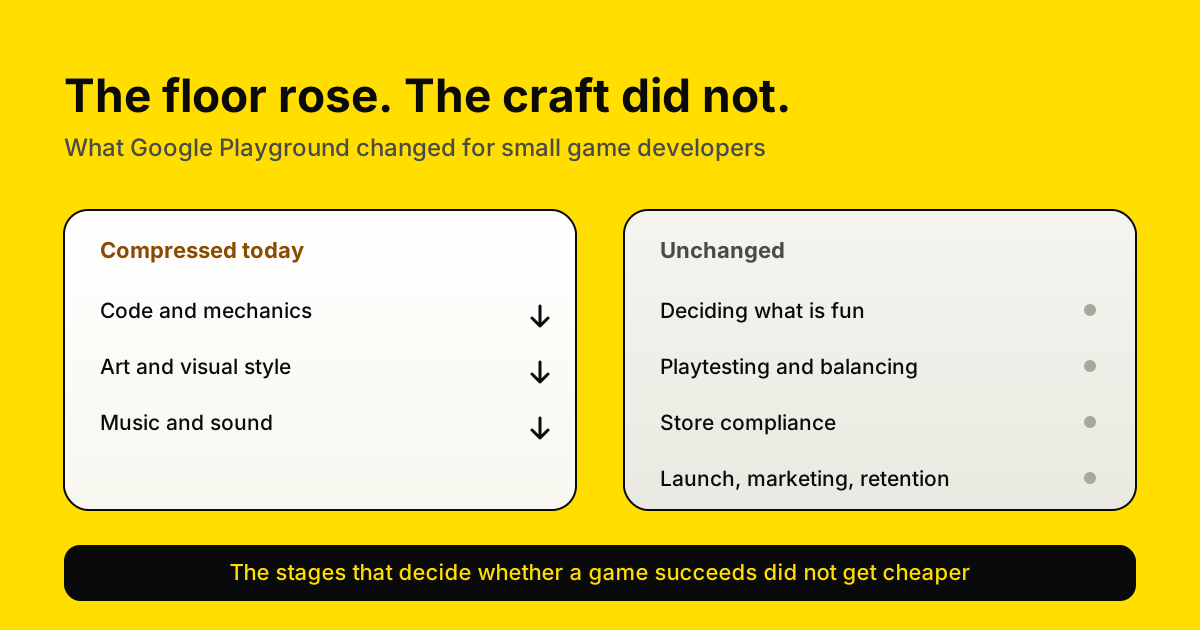
Got dramatically cheaper: writing the code and mechanics, art and visual style, music and sound. For a solo developer those were often the entire budget.
Did not move: deciding what is fun, playtesting and balancing, store compliance, and launch, marketing, retention. Notice where those stages sit. They are the ones that decide whether a game succeeds. Code and art were never the bottleneck, and knowing what to build with them always was.
The survival playbook
Move toward what did not get cheaper. Five moves, in rough priority order.
1. Stop competing on the loop alone
A single mechanic with no identity around it is the exposed position. The loop is the part a model can copy. Everything wrapped around it (tone, progression, surprise, a world that feels deliberate) is the part it cannot.
2. Build what a generated game cannot have
An audience. An update cadence. Live events. A reason to come back next week. A prompt produces a static artifact with nobody behind it, and no roadmap either. Continuity is a moat a generator structurally cannot cross.
3. Use the tools for the cheap parts anyway
This is the part too many developers skip out of principle. Prototyping an idea in an afternoon is now free. That is a genuine advantage for a small team: test more ideas, kill the bad ones earlier, and spend your scarce hours on the ones with something in them. Refusing the tool is not a strategy, it is a tax.
4. Go where judgment matters
Difficulty curves. Feel. Surprise. Systems that interact. These are exactly the places generation is weakest, and they are the places players remember. If you are not sure where your game's judgment lives, that is the first thing to fix, before you touch any tool.
5. Treat your store presence as an asset
Playground games live inside Playground. Export hands you HTML, JavaScript, CSS, and asset files. That is a web page, not an Android project. None of the layers above it got easier: no wrapper, no app bundle, no developer account, no testing, no review. Your listing, your installs, your ratings, and your testing history are not things a prompt produces. A published Android app is still a position that has to be earned, and it is worth slightly more than it was last month.
The stage nobody compresses
That fifth point deserves its own section, because it is where hopeful submissions die.
If your developer account is a personal account created after 13 November 2023, Google requires a set number of testers opted in and testing continuously for 14 days before you can apply for production access. That requirement applies to a game built in six months and to a game built in six minutes. Generative models changed the economics of writing a game. They did not change a single line of Play Console policy.
Most developers try to solve this with friends and family. The counter stalls, the testing never really happens, the application gets refused, and three weeks are gone.
This is the part of shipping a game that a prompt cannot touch, which is exactly why it is worth paying to solve. Console Testers puts 30 verified testers on your track and keeps them there across the full window, so you reach the end of the 14 days with a real count and a report you can paste straight into the production access form.
What would have to change for this to get much worse
The claim that this gets much worse rests on four conditions, and only one of them looks safe.
- Models keep improving. Likely, but an expectation, not a fact.
- Google keeps paying for generation. Unknown. There is a weekly token allowance and a waiting list for a reason. A metered product is a different thing than a free and unlimited one.
- Players accept generated games. Contested, and moving against it. Negative developer sentiment roughly tripled in two years, and storefronts now ask for AI disclosure.
- Creators can earn from it. Absent. No revenue share announced means people are making things for a gallery, not for a living.
Watch those four. The moment creators can earn, or rationing stops mattering, or a generated game shows up somewhere other than Playground (inside an assistant, on an Android surface), the calculus changes. Until several of those happen, this is a well funded experiment with a clear direction and an unknown timeline.
The honest bottom line
The floor rose. The craft did not get cheaper, the audience did not get easier to reach, and the store did not lower its bar. If your game is a loop with no identity and no audience behind it, you are in the exposed position. The tools are not what put you there, they just made it visible.
If your game has judgment in it, an audience you are building, and a real presence on the store, this month made your position slightly stronger, not weaker.
Do not panic. Do not ignore it either. Move toward the parts that did not get cheaper, and start treating the boring stages (testing, compliance, retention) as the moat they have quietly become.
Sources
- Google Labs: Playground and the Playground help center, for what the platform does and how creation is rationed.
- TechCrunch: Google experiments with an AI powered gaming platform, 7 October 2026.
- 9to5Google: Google Labs announces Playground, 7 October 2026, for the Gemini, Nano Banana and Lyria stack.
- Game Developer: Unity unveils Unity Spark, for the Unity runtime and the Asset Store.
- GDC: 2026 State of the Game Industry, more than 2,300 professionals surveyed.
- Google Play Console help: app testing requirements for new personal developer accounts, for the closed testing requirement.